
So many told me their takeaway from last week’s Global Sustainable Tourism Summit was this:
“Make sustainability the default,
and make unsustainable choices more of an effort.”
The beauty of this impactful tip is that it can be considered and applied in so many circumstances.
How to help sustainability be the default for tourism businesses
It’s clear that today’s travellers expect tourism offerings to be sustainable, and that nature (which drives half of travel demand) and maintaining a safe climate demand urgent protective action.
If we want operators to become sustainable, we have to make sustainability the path of least resistance. If being sustainable requires extra brainpower or physical effort, most business owners will skip it – not because they don't care, but because they are simply too busy - even though it is so good for business.
Here are some tips for how destination managers can make sustainability the default option for tourism operators.
1. Make learning easy
Help operators learn what to do, such as by adding a short sustainability tip to every newsletter and at every networking event.
Provide easy-to-understand dot points on what a business can do, such as the top most impactful ways to save money by reducing energy use, or how to provide a personalised, meaningful Acknowledgement of Country, or how to make a sustainable choice the default and easiest option for guests.
Run informal peer-to-peer master classes or site visits. For example, take a group of operators to a local caravan park or lodge that has successfully implemented circular economy waste loops or solar micro-grids. Let the host operator explain how it streamlined their staffing hours and boosted their guest reviews.
Example: Destination managers can sign their region up to ATIC’s Tourism Emission Reduction Program as a cohort, so operators can collaboratively reduce their emissions, and see their progress as a ‘destination team’. No one wants to look at a dashboard and see they are lagging behind the regional baseline. This subtle peer comparison can spark a friendly competition, nudging operators to independently improve to elevate their dashboard status.
2. Make procurement easy
Curate a supplier directory - a pre-verified list of suppliers of eco-friendly products, such as guest amenities and biodegradable cleaning products.
Facilitate group discounts or bulk buy schemes for business owners in your region.
Example: Plastic Free Noosa’s eco-friendly suppliers directory
3. Feature certified operators in marketing
Set up the destination website and visitor guide to showcase businesses with sustainable certification or eco-features: premium placement by default.
Have Eco-Friendly, Locally Sourced, and Nature-based filters as some of the first search options for visitors.
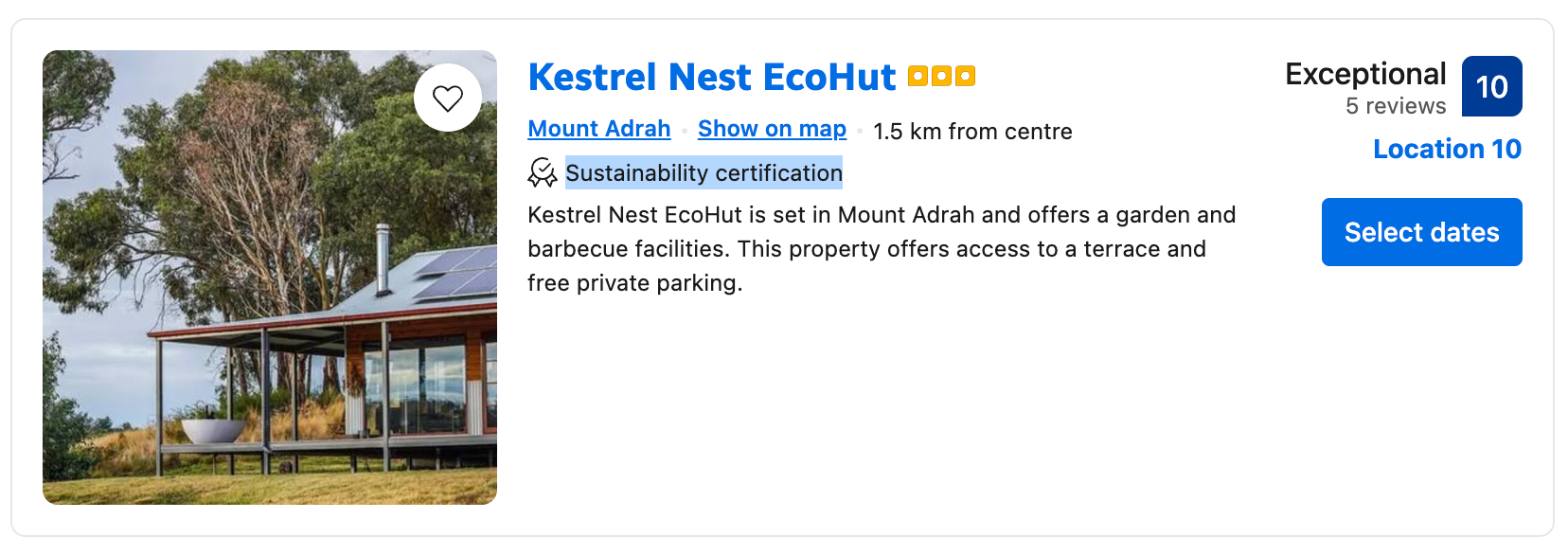
Booking.com is highlighting sustainability certifications of accommodations
Example:Toowoomba Healthy Food Coop is a Facebook group that uses posts, Google forms, spreadsheets and deadlines to organise regular wholesale-priced bulk buys of expensive health foods from online suppliers for residents.
4. Prioritise sustainability in grants and awards
When applying for competitive grants and awards, provide extra points to businesses that are sustainably certified.
To be eligible for funding for infrastructure, require that operators show how sustainability is built into their development.
Example: Tourism Tropical North Queensland aligned local tourism award criteria with certification criteria (Environmental Management, Socio-Economic Impact, Cultural Engagement, and Corporate Governance). For operators who have applied for certification, much of their award submission has effectively already been written.
Example: The Queensland Government’s very competitive Regional Tourism Infrastructure Fund provides extra points to businesses with Sustainable Tourism accreditation, and let operators know this in advance so they can become certified in the lead up to the grant’s opening.
5. Prioritise supply to local government
To register as a preferred supplier or vendor for the Council (such as to host business meetings or guests of the Council, or for familiarisation trips), prioritise those with sustainability certification (and hence third party verified risk management).
In these ways, your pitch to businesses is clear:
If you do the work to improve your sustainability, we will support your business’ bottom line.
Over to you
What are your good ideas to help nudge operators towards adopting sustainability? We’d love to hear them!