
A simple guide to strategy success in 2026
We've all seen beautiful tourism development strategies that end up sitting on a shelf, forgotten.
At Tilma, one of our underpinning values is ‘outcomes focused’ — we care deeply about our clients and strive to drive measurable outcomes, using the visitor economy to benefit rural and remote communities and Australia’s beautiful nature.
So when we see strategies gathering dust or, even worse, when we commence the development of a strategy with a new client and then discover that they have an existing strategy that is still relevant, we raise the red flag.
We recently decided to do a brief survey of Tilma clients and industry colleagues to learn—from the source—about why DMPs are not being implemented.
The results clearly showed why these plans fail—and the answer is simple:
Destination managers tend to focus more on writing plans and not enough on doing the work.
A strategy gathering dust is like a detailed treasure map that's framed on the wall instead of being used on the expedition-you know where the treasure is, but without boots on the ground, the right gear, and regular check-ins to make sure you haven't strayed, the objective remains purely theoretical.
If we want our tourism strategies to work in 2026, we must change this, and Tilma is on a mission to lead this change!
The three main reasons tourism strategies fail
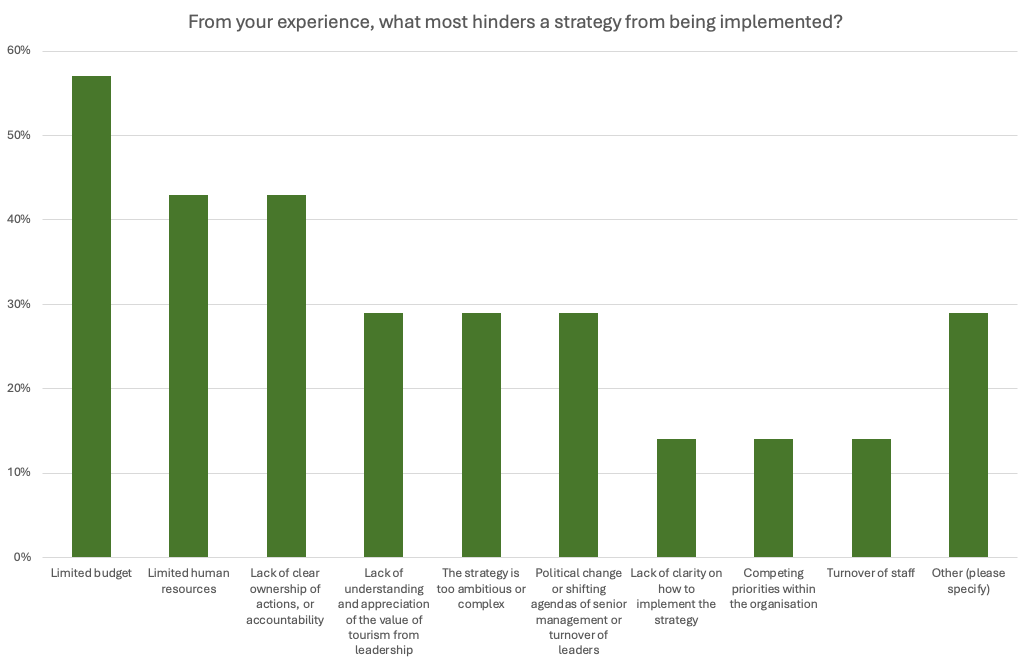
Our survey asked what stops a tourism strategy from being put into action. The answers point to three major problems: money, ownership, and clarity.
1. The Money Problem (Resources)
The single biggest factor that helps a strategy succeed is support from leadership with allocated budget and human resources. Simply put: a strategy often fails because it isn’t resourced (or doesn't align with existing resourcing).
Financial pressures are increasing, making funding harder to secure, especially in local government.
“I think it can be too easy for councils to obtain funding for strategic planning and once done say, ‘Great, that box is ticked,’ and move on... Councils need to understand the cost of doing nothing!”
“If the visitor economy industry is involved with the development [of a tourism strategy], and with actions, they can contribute to the positive-outcomes-focussed approach, and maybe also keep staff accountable.”
2. The Responsibility Problem (Accountability)
The majority of survey respondents agreed that a lack of clear accountability or ownership of actions really impacts implementation.
This happens when the tourism team is responsible for a tourism strategy, but its actions require work from other teams (such as community development, arts and culture, or sport and recreation) who are focused on delivering their own plans.
Furthermore, turnover of staff and political change or shifting agendas of senior management undermine continuity and ownership of delivering the strategy. One client pointed out the issue of a "Lack of leadership and ownership amongst Council departments".
“Handing over a strategy is one thing, handing over ownership is the linchpin. There’s more responsibility on the organisation than on the consultant, but there is a role [for consultants] to set that up and enable that from the beginning of the process.”
3. The Complexity Problem (Clarity)
Many strategies are simply too complicated or ambitious! Many respondents cited a lack of clarity on how to implement the strategy.
“Too much focus is on plan development and not enough on measurement, accountability and transparency”
“I feel that any strategy needs to have a clear and concise Step 1, including who is responsible to action it and when. I find it’s super important to implement the first initial actions ASAP to keep momentum and ensure staff and stakeholders don’t get occupied by other tasks”
Ensuring success
To ensure success in 2026, we must change how we create and deliver these plans. A strategy should be designed to be "impossible not to implement"—this is Tilma’s mission.
Our days of simply developing a strategic plan are over. Strategy success in 2026 will be defined by accountability, clear resources, and mandated follow-up.
We must stop treating a plan as the outcome; it is only the beginning.
If this resonates with you, and you want help with accountability to deliver your existing tourism-related strategy, or you are ready for a new one which will actually get implemented, we’d love to work with you.