
By Kayla Bauer
Rain drums steadily on the roof of The Regent Cinema in Murwillumbah, New South Wales.
Outside, paddocks are saturated and grey clouds hang low across the Tweed Valley. Inside, however, the mood is markedly different as farmers, tourism operators, government representatives, and industry leaders gather for the 2026 Agri & Aqua Tourism Summit.
The room is welcoming. The coffee warm. Lively conversations have spilled from the hallway into the conference space, and there is an unmistakable sense of energy.
Then the laughter starts.
"It was harder than med school."
The comment comes from Sheridan Beaumont, Founder of the successful Sydney Oyster Farm Tours, speaking candidly from the stage.
"I'm not kidding," she says. "I went to medical school, and getting through the approvals was harder than that."
Across the room, heads nod in agreement. The laughter isn't really about a joke... it's the sound of shared experience.
Sheridan's story resonates because it isn't unique. While Sydney Oyster Farm Tours has become an internationally celebrated and highly Instagrammable Australian agritourism experience, even its founder was left exhausted by the complexities of approvals and compliance. Throughout the day, similar stories emerge from farmers, producers and tourism operators who have spent months, often years, navigating the same process.
And yet, the demand for their product has never been greater.
At the Summit, we were reminded how across Australia visitors are increasingly seeking experiences that allow them to connect with the people and places behind the food on their plate. They want to walk through sunflowers with the grower, learn about regenerative farming practices, sip gin at a local distillery, shuck oysters where they're harvested, and hear firsthand the stories that shape regional communities.
With demand continuing to grow, the conversation shifted from why agritourism matters to how we can make it easier.
That question formed the basis of a panel discussion led by Tilma Group’s Managing Director, Linda Tillman. Bringing together leaders from agriculture, tourism, local government and policy, the session took a frank look at the barriers farmers continue to face when exploring agritourism, from planning approvals and taxation to insurance, regulation and inconsistent definitions.
What made the discussion particularly significant was not the challenges themselves, but the feeling of industry alignment.
For years, farmers have felt caught between competing messages. Governments encourage diversification. Tourism organisations actively promote agritourism. Yet when a farmer begins exploring visitor experiences, they can find themselves navigating complex and very expensive approval pathways, as well as uncertainty around issues such as taxation, land use classifications and primary producer status.
The conversation in Murwillumbah suggested the agricultural industry is increasingly advocating for solutions. While passionate agritourism advocates have been progressing this work for years, there was a noticeable sense that the conversation is broadening, with agriculture, tourism and government becoming increasingly aligned on the need for reform.
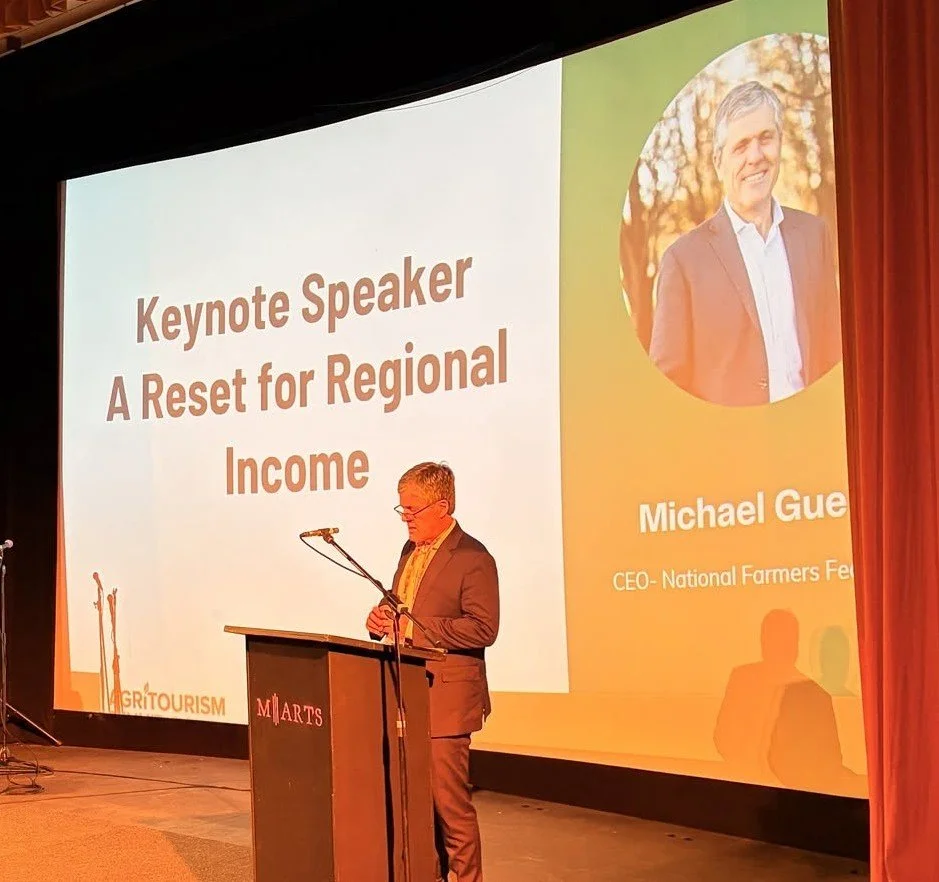
Michael Guerin, CEO of the National Farmers' Federation calling for national reform.
A united voice for reform
No speaker embodied that shift more clearly than Michael Guerin, CEO of the National Farmers' Federation.
Michael acknowledged agritourism as a legitimate diversification strategy which can help strengthen farm businesses, support succession planning, and build resilience during difficult seasons.
The challenge, he explained, is that farmers currently must navigate multiple layers of regulation simultaneously. Planning requirements may sit with local government, while taxation, workplace obligations, succession planning, and health and safety can span state and federal jurisdictions.
Rather than focusing on a single policy change, Michael's message centred on something bigger: unity.
Regional Australia, he argued, must speak with one united voice and advocate for national reform. Greater national consistency is needed to reduce the complexity farmers face across jurisdictions and ensure they can diversify through genuine agritourism without jeopardising their status as primary producers.
With a federal election looming in 2028, Michael encouraged delegates to see the coming 18 months as a significant opportunity to influence national reforms.
His advice on what we can all do was straightforward:
Engage your local state and federal Member of Parliament (MP) and inform them of your agritourism venture and any current struggles. Bring them along on the journey. You can find your local electorate here.
Join the industry body that best represents your sector (that could be the Australian Agritourism Network, Agritourism Queensland, Agritourism Tasmania, Western Australia Agritourism Association, Australian Women in Agriculture, Canegrowers Australia, Dairy Australia, Cattle Australia, Seafood Industry Australia and more). Inform them about your agritourism venture, see what support they may offer.
Attend AgXchange 2027 ahead of the federal election. Hosted by the National Farmers' Federation, the event brings together representatives from across Australia's agricultural supply chain to discuss the issues shaping the sector's future, and advocate for change.
For destination managers, this was an important reminder that supporting agritourism extends well beyond product development and marketing. If regions want more farm-based visitor experiences, they also need to support the policy and advocacy work that helps make those experiences viable.
The certainty farmers are asking for
While reform was a major theme, another word surfaced repeatedly throughout the discussion: certainty. At Tilma, we’ve spoken about this before.
Destination North Coast Managing Director, Michael Thurston, captured the challenge perfectly when he warned that, in some cases, success itself can create struggle and uncertainty, “If you become too successful in this, it can blow everything up.
It was a comment that generated plenty of discussion because many operators understood exactly what he meant. When tax treatment, land use classifications and primary producer status remain uncertain, a successful agritourism venture can create unintended consequences. Michael pointed to Victoria's approach as an example worth examining, noting that assessments are based on the proportion of primary land use rather than income alone.
Practical advice farmers can act on now to make agritourism easier
While the hoped long-term reform will take time, the panel also offered practical guidance that farmers can implement now.
Revenue NSW Senior Advisor, Vishal Sharma, encouraged operators to begin documenting their outputs and inputs from day one. Time, labour, finances, resources and operational inputs should all be carefully recorded across both the agricultural business and any tourism-related activities.
Good record keeping can help farmers demonstrate the relationship between their primary production activities and ancillary tourism operations, particularly when questions arise around taxation or exemptions.
Building on that advice, Tropical Fruit World General Manager, Aymon Gow, pointed to the growing range of digital tools available to farmers. Apps that record operational inputs and outputs can make compliance significantly easier throughout the day-to-day, particularly during busy seasons when businesses are juggling visitors alongside agricultural production.
Choosing the right lane
Denise Galle, Director of Planning and Regulation at Tweed Shire Council, offered practical advice by sharing her explanation of agritourism approvals.
In NSW, she explained, agritourism must satisfy two tests:
The agritourism activities must operate on a commercial farm
They must be ancillary to that farming operation.
From there, operators generally move into one of three approval pathways, which Denise described as swimming lanes.
The first lane is exempt development, which is generally the simplest lane and the one you want to be in… but also the one that currently produces the most uncertainty and inflexibility
The second lane is compliant development – a quicker approval pathway than a full Development Application, but only for developments that satisfy a set of strict conditions.
The third lane is a full Development Application process – the longest and hardest lane, and often the most costly, but can be the most flexible.
Her advice was clear: talk to council before starting.
Before engaging consultants, constructing infrastructure or lodging applications, have a conversation with your local council planning team. Because understanding which lane you're in from the outset can save significant time, money and frustration further down the track. Denise warned that once you’re in a lane, it’s very difficult to switch into another.
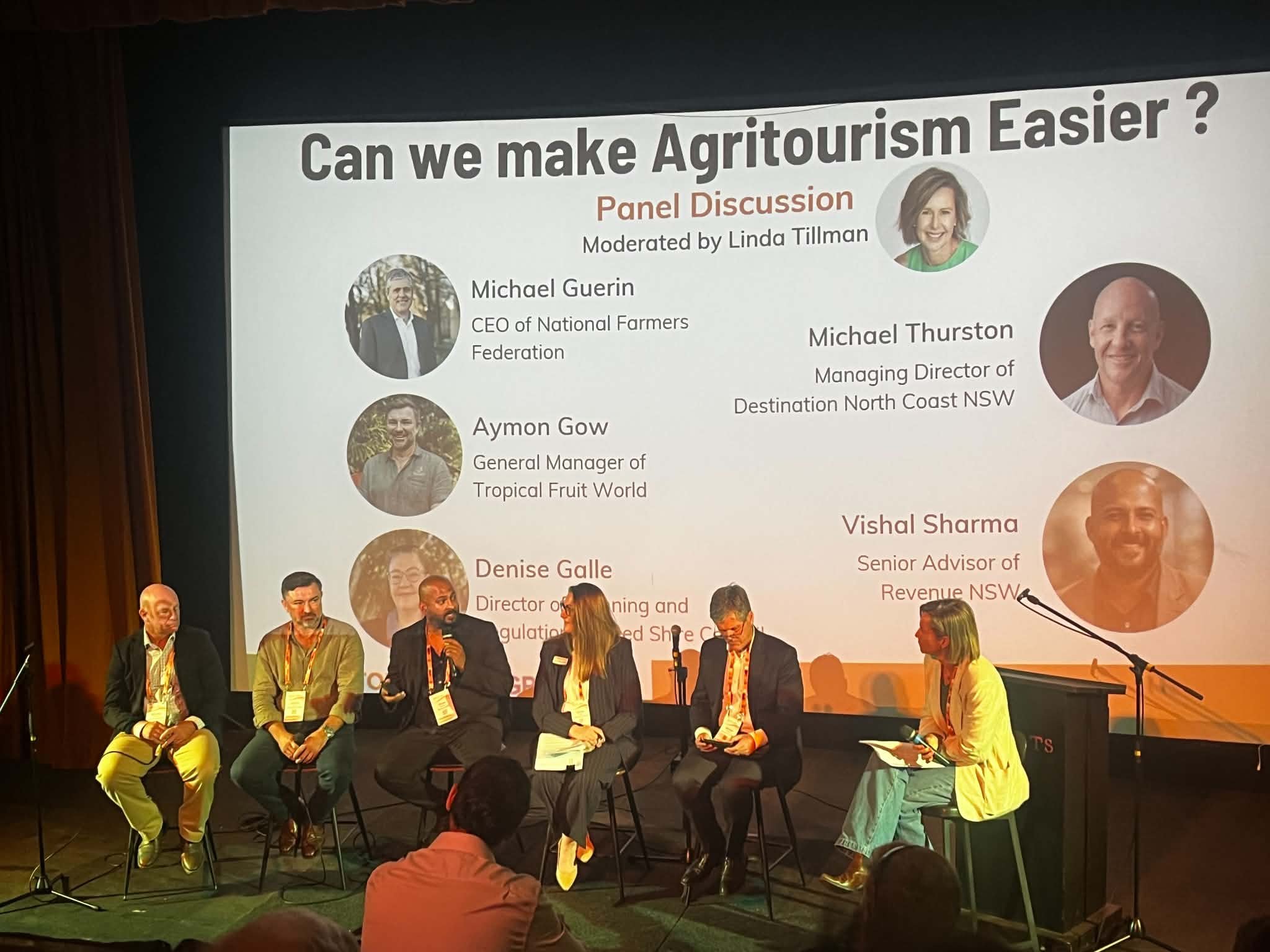
Tilma’s Managing Director, Linda, facilitating a panel on Can we Make Agritourism Easier?
The applause heard around the room
As the session drew to a close, Linda brought the discussion back to a simple but powerful proposition: agritourism should be an achievable diversification opportunity and value add for farmers who have the right assets, passion and circumstances to pursue it.
Her proposed solution was straightforward.
Australia needs a nationally consistent definition of agritourism, and recognition that genuine agritourism, where tourism remains ancillary to a working farm and supports the core agricultural enterprise, should be treated as primary production under national legislation.
Before she finished, the audience responded with a spontaneous round of applause.
It reflected something that had emerged throughout the discussion: a growing sense that farmers, tourism organisations, councils and industry bodies are becoming increasingly aligned on that solution. Calls for a nationally consistent approach to agritourism, coupled with stronger advocacy from industry, suggest the conversation is shifting from local challenges towards the possibility of national reform.
An encouraging sign for an industry that has spent years calling for greater clarity.
Outside, the rain continued to fall across the Tweed Valley, the landscape fading into misty shades of green and grey. Inside The Regent Cinema, conversations lingered long after the session ended.
No single panel was going to solve the challenges facing agritourism. But there was a growing sense that the industry's advocates were no longer working in silos, with voices from agriculture, tourism, government and regional development rallying behind a shared case for change.
If the discussion in Murwillumbah proved anything, it is that the push to make agritourism easier is no longer coming from a single corner of the industry. The advocacy is growing louder, the voices are becoming more united, and the case for reform is becoming increasingly difficult to ignore.
Need help navigating the agritourism journey?
At Tilma, we work with farmers, councils and destination organisations across Australia to make agritourism easier to understand, assess and implement. Whether you're exploring an idea for the first time, working through planning and feasibility considerations, developing a visitor experience, or looking to align agritourism with your existing farm business, our team can help.
Learn more about our agritourism development services here, or contact us at admin@tilmagroup.com.au. We look forward to hearing from you!